Originally posted at Speak Compassion
The chances of any of us being taken hostage by an armed madman are thankfully pretty low. On the other hand, our chances of being held psychological hostage to our own fears or the control of others is pretty high. In fact, I would bet to say many of us are psychological hostages to the unresolved conflicts in our lives. George Kohlrieser has been a professional hostage negotiator for decades and brings his years of conflict resolution skills in compact form in the book, Hostage at the Table.
From the get-go this book is captivating with stories of hostage situations taken from Kohlriser’s own experiences as a hostage negotiator. By explaining the nature of conflict and the biology of the “fight or flight” nature of our minds, he gives us a clear picture of why so many of us are being held psychological hostages. He takes us through the skills hostage negotiators use to resolve conflicts and shows how those same skills can be used by business leaders, parents and educators to prevent us from being psychological hostages to the everyday conflict that comes up in our lives. Noting that hostage negotiators have a success rate of over 90 percent, this book offers skills to make life more wonderful by learning to deal with conflict.
I found that most of this book and its offerings fit really well with the foundations of Nonviolent Communication. Kohlriser talks about the importance of “bonding and attachment” and learning to bond even with an ‘enemy’ and becoming a “secure-base” are the keys to never thinking like a hostage. He talks extensively about how the bonding process is one of the key skills all hostage negotiators use to create a safe space where dialogue and negotiation can occur. He stresses the importance of connection, which is the goal and purpose of Nonviolence Communication. For this reason, I would recommend all NVC practitioners read this book. I would also urge all business leaders, community activists and politicians to also read this book.
Kohlrieser uses an interesting metaphor in his book that he calls, “putting the fish on the table” where he compares conflict resolution to cleaning and gutting fish. It is a rather gross and bloody metaphor and it works beautifully by noting that when we leave the fish under the table, they fester become toxic and rot under the table and when we put the fish on the table and do the work of gutting and scaling, we are working toward a beautiful dinner that we can enjoy. His point being that to live a beautiful life, we need to put our fish on the table and deal with the mess before we can move on to the beauty of life.
Kohlrieser points out that all hostage takers have suffered great loss. For almost every event of shootings, hijackings, or people barricading themselves into their homes, we find the individuals have suffered great losses. Whether it was a job, the death of a loved one or the loss of one’s home. 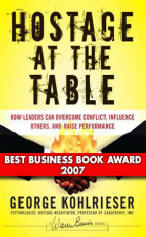
Some of Kohlrieser’s guidelines for solving conflict:
- Put the “fish on the table”
- Bond, even with an enemy
- Understand the role of loss and pain in generating conflict
- Never think like a hostage
- Use the power of negotiation
- Be a secure base
- Separate the person from the problem
- Master your mind’s eye and focus on positive goals
_
An important thing I would like to note about this book is how Kohlrieser explains that the research shows that a person is incapable of killing another person. First, they must dehumanize them to where they are seen as an object. By creating a bond with their captors, many people have managed to stay alive. In the opening story, Kohlrieser tells of a grandmother who bonds with a man who broke into her house in the middle of the night by offering to cook him dinner and give him a place to sleep. Later, in the morning they discover the man was a psychopathic murderer who had murdered the family who were the nearest neighbors. This lesson about bonding and dehumanizing is a valuable lesson to understanding hate crimes and the part that “hate speech” plays in these crimes. By dehumanizing gays and lesbians, blacks, immigrants, and others into objects rather than people, it is easier for everyday people to justify violence against them. This is why it is so important that we bond and create dialogue with those who create such speech so they understand the outcomes of their words.
You can read the first chapter of the book, including the story of the grandmother here. (PDF files and requires AcrobatReader)